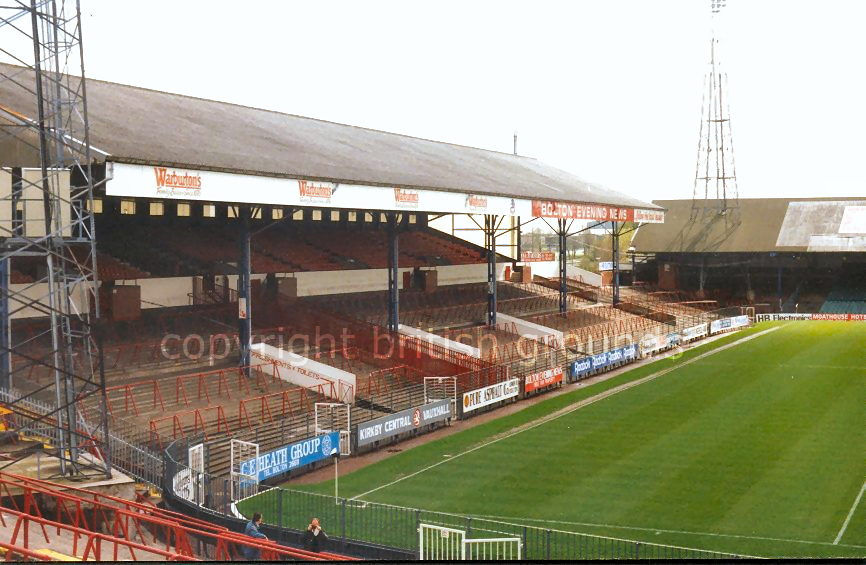
One of the twelve founder members of the Football League, the Wanderers were originally known as Christ Church when they were formed in 1874 by Sunday School teacher, Thomas Ogden. The present name was adopted in 1877 by a breakaway group when the Christ Church president began to stress too many rules about the use of the church premises. The suffix Wanderers was added to commemorate their long search for a permanent headquarters.

During their first years the Wanderers, living up to their name, switched home quite frequently. Rather than thinking of properly enclosed grounds, imagine yourself on little more than open fields. The first game played by the club, in July 1874, was a trial match which was held at Bob Woods field on what is now the east side of Heaton Cemetery. This was followed by an encounter at Smithfield. After spells at The Park Recreation Ground, Dick Cockles Field and Pikes Lane, the Wanderers finally settled at Burnden Park which was to be their home for 102 years until Bolton Wanderers moved to The Reebok Stadium as the 1996-97 first division champions.
 Bolton may have wandered to find a permanent home, and the same can be said about their sartorial endeavours. Bolton’s club colour history is colourful indeed. The first “costume” was red and black, followed by red and white quarters, giving way to salmon pink jerseys, only to be replaced by white shirts covered with red spots in 1884. The sight of this was too much for the Bolton correspondent of the local Football Field paper. We quote: “I have seen a great variety of shirts and jerseys as most folks, but must award the palm of uniqueness to the new fangled dress of the Wanderers. It is something like you would expect in a circus ring”. Incidentally, the nickname “The Spots” remained with the Wanderers for many years afterwards.
 Bolton acquired white shirts from the former Turton Club in 1885. Apart from the one exception of blue and white stripes in 1890, they have remained white since, with blue shorts. How appropriate that it was a white horse that cleared the Wembley pitch in 1923 prior to the FA Cup final…..
Bolton Wanderers are referred to as ‘The Trotters’, trotter being a local name for a practical joker. Although pigs’ trotters were a local delicacy, and although there was a butchers close to Bolton’s former ground at Burnden Park where the players used to go and eat pigs’ trotters before matches and although this pre-match routine stopped- certainly after the team moved to the Reebok Stadium-, it did not account for the illustrious nickname.
 Bolton have had a string of emblems, appropiate for a club with the suffix Wanderers. Today’s crest is not the most appealing affair, as seems to be the case with so many other computer animated designs. It is in sharp contrast to older emblems that one way or another were always inspired by the old Bolton County Borough Council coat of arms.
 On the first insignia we see two gold and diagonal bendlets to represent the shoulder-belt of a soldier; this was in use before the arms were officially granted. For appropiate difference were added an arrow, in reference to the part played by the Bolton Archers at Flodden in 1513, a shuttle and Samuel Compton’s mule spindle for the textile industry, introduced by the Flemish weavers who settled in the area in the 14th century. Finally, we see the red rose, symbolic of Lancashire.
 Another version of Bolton Wanderers’ emblems shows an elephant on top of a shield with, not surprisingly, the letters ‘B’ and ‘W’, on a blue blackground. The elephant, together with a castle, now also appears in the crest of the present Bolton Metropolitan Borough Council coat of arms and is said to be the evidence of Bolton’s historic connection with Coventry. The link goes back to the middle of the 13th century when Bolton Church was annexed as a prebend to the Cathedral Church of Lichfield and came under the authority of the Bishop of Coventry and Lichfield, suggested by the mitre on the tapping, which bears the Coventry civic colours of red and green.

 The Beautiful History
Is all the above totally true & confirmed? If so, great stuff, & plenty I didn’t know about my own club that I’ve supported since 1977!
Rob C.
Can you tell me why Raikes Lanes was called such when Raikes Lane was miles away over by where they built Burnden Park? So who’s ground was it then off the real Raikes Lane in a field next to Bolton Showground circa 1890?
The current club badge is a slightly modified version of the one which emerged in the early 70s – the result of a public competition for ideas if I remember correctly.
Can anyone tell me anything about Bolton Olympic from the 1880s?
anybody know anything about England playing Bolton wearing Bolton shirts at Burnden Park april 1960?
Please have a go at http://www.itv.com/news/granada/2015-03-19/gallery-jimmy-armfields-illustrious-career/
and jump to the second picture.
Answer provided by George Chilvers, Wigan
Does anyone know what the club’s away kit for 1954/55 was?
did Bolton Wanderers ever have two or three players in the same England team please?
I’m sure that at one time when i went to burnden park in the 60’s/70’s a schoolboy used to parade a pig round the pitch on a stick. This was called ‘happy the wanderer’. Can anyone confirm this as none of my friends believe me.
Thank you, very interesting, I have been a Bolton fan since my sister took me to my fist game when I was 5, I am now 60, it’s always nice to read the history of our great club, but you should on mentioned wanders at war, and the sad Burnden disaster in respect to all those who died